Titanic


Hi readers, here this is going to be a topic about a world’s famous ship. I think you had guessed what the post is going to be about…. Yes you are correct; it is going to be about Titanic. RMS Titanic was an Olympic-class passenger liner owned by the White Star Line and built at the Harland and Wolff shipyard. On the night of 14 April 1912, during her maiden voyage, Titanic struck an iceberg, and sank two hours and forty minutes later in early 15 April 1912. At the time of her launching in 1912, she was the largest passenger steamship in the world.

The sinking resulted in the deaths of 1,517 people, ranking it as one of the worst peacetime maritime disasters in history and by far the most infamous. The Titanic used some of the most advanced technology available at the time and was popularly believed to be “unsinkable” - indeed, in a 1910 White Star Line brochure advertising the Titanic, it was claimed that she was "designed to be unsinkable". It was a great shock to many that despite the advanced technology and experienced crew, the Titanic still sank with a great loss of life. The media frenzy about Titanic's famous victims, the legends about what happened on board the ship, the resulting changes to maritime law, and the discovery of the wreck in 1985 by a team led by Robert Ballard have made Titanic

The Titanic was a White Star Line ocean liner, built at the Harland and Wolff shipyard in Belfast, Ireland, designed to compete with rival company Cunard Line's Lusitania and Mauretania. The Titanic, along with her Olympic-class sisters, the Olympic and the soon to be built Britannic (originally named Gigantic), were intended to be the largest, most luxurious ships ever to operate. Construction of the RMS Titanic, funded by the American J.P. Morgan and his International Mercantile Marine Co., began on 31 March 1909. Titanic's hull was launched on 31 May 1911, and her outfitting was completed by 31 March the following year. Titanic was 882 ft 9 in (269 m) long and 92 ft 6 in (28 m) wide, had a gross register tonnage of 46,328 tons, and a height from the water line to the boat deck of 60 ft (18 m). Titanic contained two reciprocating four-cylinder, triple expansion, inverted steam engines and one low pressure Parsons turbine which powered three propellers. There were 29 boilers fired by 159 coal burning furnaces that made possible a top speed of 23 knots (43 km/h). Only three of the four 63 feet (19 m) tall funnels were functional; the fourth funnel, which only served as a vent, was added to make the ship look more impressive. The ship could hold a total of 3,547 passengers and crew and, because she carried mail, her name was given the prefix RMS (Royal Mail Steamer) as well as SS (Steam Ship). There were insufficient lifeboats on the Titanic for all passengers, thus this one led to loss of many lives and it finished its voyage with a sad ending……..

About it…

Class and type: Olympic-class ocean liner

Tonnage: 46,328 gross register tons (GRT)

Displacement: 52,310 tons

Length: 882 ft 9 in (269.1 m) Beam: 92 ft 6 in (28.2 m)

Draught: 34 ft 7 in (10.5 m)

Installed power: 24 double-ended (six furnace) and 5 single-ended (three furnace) Scotch boilers. Two four-cylinder reciprocating triple-expansion steam engines each producing 15,000 hp for the two outboard wing propellers at 75 revolutions per minute. One low-pressure turbine producing 16,000 hp. 59,000 hp was produced at maximum revolutions.

Propulsion: Two bronze triple-blade wing propellers. One bronze quadruple-blade centre propeller.

Speed: 21 knots (39 km/h/24 mph)maximum 23 knots

Capacity: 3,547 passengers and crew, fully loaded


Seahorse


Hi friends it will be interesting to know about species living in water… If it is about an unknown species means, then it will be more exciting… Now our topic is going to be about seahorses. They are so named for their equine appearance. Although they are fish, they do not have scales, rather a thin skin stretched over a series of bony plates arranged in rings throughout their body. Each species has a distinct number of rings. Seahorses swim upright, another characteristic that is not shared by their fish relatives who swim horizontally. Seahorses have a coronet on their head, which is distinct to each seahorse, much like a human fingerprint. They swim very poorly by using a dorsal fin, which they rapidly flutter to propel them, and pectoral fins, located behind their eyes, which they use to steer. Because they are poor swimmers, they are most likely to be found resting in sea grasses or coral reefs with their prehensile tails wound around a stationary object. They have long snouts, which they use to suck up food, and eyes that can move independently of each other much like chameleon. Seahorses eat small shrimp, tiny fish and plankton.

About their birth...

The male seahorse can give birth to as few as 5 and as many as 2,000 "fry" at a time and pregnancies last anywhere from two - four weeks, depending on the species. When the fry are ready to be born, the male undergoes muscular contractions to expel them from his pouch. He typically gives birth at night and is ready for the next batch of eggs by morning when his mate returns. Like almost all other fish species, seahorses do not care for their young once they are born. Infants are susceptible to death from predators or being swept into ocean currents, where they drift away from rich feeding grounds or into temperatures too extreme for their delicate bodies. Fewer than five infants of every 1,000 born survive to adulthood, helping to explain why litters are so large. The survival rates of these infants are actually fairly high compared to fish standards, because they are initially sheltered in their father’s pouch during the earliest stages of development, while the eggs of most other fish are abandoned immediately after fertilization.

In danger!

Seahorse populations are thought to have been endangered in recent years by overfishing and habitat destruction. The seahorse is used in traditional Chinese herbology, and as many as 20 million seahorses may be caught each year and sold for this purpose. Medicinal seahorses are not readily bred in captivity as they are susceptible to disease and have somewhat different energetics than aquarium seahorses.

Import and export of seahorses has been controlled under CITES since May 15, 2004. However, Indonesia, Japan, Norway, and South Korea have chosen to opt out of the trade rules set by CITES.

Even though they are killed for medicinal use… All the countries should follow the rules and try to reduce their percentage of killing, also they should take some steps to improve their population by using some artificial methods…

Dwarf Willow


Salix herbacea (Dwarf Willow, Least Willow or Snowbed Willow) is a species of tiny creeping willow (family Salicaceae).

Leaves and seed capsules

Leaves and seed capsules

It is adapted to survive in harsh Arctic and sub-Arctic environments, and has a wide distribution on both sides of the North Atlantic, in Arctic northwest Asia, northern Europe, Greenland, and eastern Canada, and further south on high mountains, south to the Pyrenees, the Alps and the Rila in Europe, and the northern Appalachian Mountains in New York, United States. It grows in tundra and rocky moorland, usually at over 1,500 m altitude in the south of its range but down to sea level in the Arctic.

It is one of the smallest woody plants in the world. It typically grows to only 1-6 cm in height and has round, shiny green leaves 1-2 cm long and broad. Like the rest of the willows, Dwarf Willow is dioecious, with male and female catkins on separate plants. As a result the plant's appearance varies; the female catkins are red-coloured, while the male catkins are yellow-coloured.

White Tiger


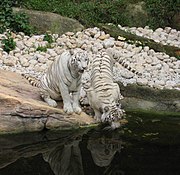
White Tiger (Panthera tigris) is a tiger with a genetic condition that nearly eliminates pigment in the normally orange fur although they still have dark stripes. This occurs when a tiger inherits two copies of the recessive gene for the paler coloration: pink nose, grey-mottled skin, ice-blue eyes, and white to cream-coloured fur with black, grey, or chocolate-coloured stripes. (Another genetic condition also makes the stripes of the tiger very pale; white tigers of this type are called snow-white.)

White tigers do not constitute a separate subspecies of their own and can breed with orange ones, although all of the resulting offspring will be heterozygous for the recessive white gene, and their fur will be orange. The only exception would be if the orange parent was itself already a heterozygous tiger, which would give each cub a 50% chance of being either double-recessive white or heterozygous orange.

Compared to orange tigers without the white gene, white tigers tend to be larger both at birth and at full adult size. This may have given them an advantage in the wild despite their unusual coloration. Heterozygous orange tigers also tend to be larger than other orange tigers. Kailash Sankhala, the director of the New Delhi Zoo in the 1960s, suggested that "one of the functions of the white gene may have been to keep a size gene in the population, in case it's ever needed."

Dark-striped white individuals are well-documented in the Bengal Tiger subspecies (Panthera tigris tigris or P. t. bengalensis), may also have occurred in captive Siberian Tigers (Panthera tigris altaica), and may have been reported historically in several other subspecies. White pelage is most closely associated with the Bengal, or Indian subspecies. Currently, several hundred white tigers are in captivity worldwide with about 100 of them in India, and their numbers are on the increase. The modern population includes both pure Bengals and hybrid Bengal–Siberians, but it is unclear whether the recessive gene for white came only from Bengals, or from any of the Siberian ancestors as well.

The unusual coloration of white tigers has made them popular in zoos and entertainment that showcases exotic animals. The magicians Siegfried & Roy are famous for having bred and trained white tigers for their performances, referring to them as "royal white tigers" perhaps from the white tiger's association with the Maharaja of Rewa.

It is a myth that white tigers did not thrive in the wild, where small groups had bred white for generations. India once planned to reintroduce them to the wild. Dunbar Brander wrote in "Wild Animals In Central India" (1923): "White tigers occasionally occur. There is a regular breed of these animals in the neighborhood of Amarkantak at the junction of the Rewa state and the Mandla and Bilaspur districts. When I was last in Mandla in 1919, a white tigress and two three parts grown white cubs existed. In 1915 a male was trapped by the Rewa state and kept in confinement. An excellent description of this animal by Mr. Scott of the Indian police, has been published in Vol. XXVII, No. 47, of the Bombay Natural History Society's journal."

Mammoth


A mammoth is any species of the extinct genus Mammuthus. These are members of the elephant family and close relatives of modern elephants. They were often equipped with long curved tusks and, in northern species, a covering of long hair. They lived from 4.8 million years ago to around 4,500 years ago.

The woolly mammoth was the last species of the genus. Most populations of the woolly mammoth in North America and Eurasia died out at the end of the last Ice Age. Until recently it was generally assumed, that the last woolly mammoths vanished from Europe and Southern Siberia about 10,000 BC, but new findings show, that some were still present here about 8,000 BC. Only slightly later the woolly mammoths also disappeared from continental Northern Siberia. Woolly mammoths as well as Columbian mammoths disappeared from the North American continent at the end of the ice age. A small population survived on St. Paul Island, Alaska, up until 6000 BC, and the small mammoths of Wrangel Island became extinct only around 2000 BC.

About there body…

Height - 5 meters (min) & 6.7 meters (max)

Weight - 6 to 12 tones

Tusk – upto 4.1 meters

Based on studies of their close relatives, the modern elephants, mammoths probably had a gestation period of 22 months, resulting in a single calf being born. Their social structure was probably the same as that of African and Asian elephants.

If such animals are still existing, it will be exciting for us to watch them and no more elephants will be called as big as well as large animals…

They were no more but still as fossils…

Disclosure Policy

This blog is a personal blog written and edited by me. For questions about this blog, please email selerines@gmail.com
This blog accepts forms of cash advertising, sponsorship, paid insertions or other forms of compensation.
This blog abides by word of mouth marketing standards. We believe in honesty of relationship, opinion and identity. The compensation received may influence the advertising content, topics or posts made in this blog. That content, advertising space or post will be clearly identified as paid or sponsored content.
The owner(s) of this blog is compensated to provide opinion on products, services, websites and various other topics. Even though the owner(s) of this blog receives compensation for our posts or advertisements, we always give our honest opinions, findings, beliefs, or experiences on those topics or products. The views and opinions expressed on this blog are purely the bloggers’ own. Any product claim, statistic, quote or other representation about a product or service should be verified with the manufacturer, provider or party in question.

Airbus


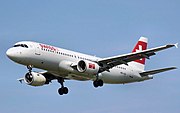
Here we will see about the Airbus and its history. Airbus Industrie began as a consortium of European aviation firms to compete with American companies such as Boeing, McDonnell Douglas, and Lockheed.

While many European aircraft were innovative, even the most successful had small production runs.In 1991, Jean Pierson, then CEO and Managing Director of Airbus Industrie, described a number of factors which explained the dominant position of American aircraft manufacturers: the land mass of the United States made air transport the favoured mode of travel; a 1942 Anglo-American agreement entrusted transport aircraft production to the US; and World War II had left America with "a profitable, vigorous, powerful and structured aeronautical industry."

In the mid-1960s, tentative negotiations commenced regarding a European collaborative approach. Individual aircraft companies had already envisaged such a requirement; in 1959 Hawker Siddeley had advertised an "Airbus" version of the Armstrong Whitworth AW.660 Argosy, which would "be able to lift as many as 126 passengers on ultra short routes at a direct operating cost of 2d. per seat mile." However, European aircraft manufacturers were aware of the risks of such a development and began to accept, along with their governments, that collaboration was required to develop such an aircraft and to compete with the more powerful US manufacturers. At the 1965 Paris Air Show major European airlines informally discussed their requirements for a new "airbus" capable of transporting 100 or more passengers over short to medium distances at a low cost. The same year Hawker Siddeley (at the urging of the UK government) teamed with Breguet and Nord to study airbus designs. The Hawker Siddeley/Breguet/Nord groups HBN 100 became the basis for the continuation of the project. By 1966 the partners were Sud Aviation (France), Arbeitsgemeinschaft Airbus, later Deutsche Airbus (Germany) and Hawker Siddeley (UK).

Headquarters Toulouse, France

Key people Thomas Enders, CEO

Hans Peter Ring, CFO

John Leahy, Chief Commercial Officer

Fabrice Brégier, COO

Industry Aerospace

Products Commercial airliners (list)

Revenue $39 billion USD (FY 2006)[1]

Employees 57,000 [2]

Parent EADS

Subsidiaries Airbus Military

Website www.airbus.com

About this blog

Hi friends, welcome to my blog. In this blog you can able to know some information about the matters that are not explored to you well (i.e. some unusual things). Enjoy reading my blog and have a nice time.
Update in this blog will be done at least once in 4 days...