Showing posts with label Nature. Show all posts

Help me...

Thanks to the acceleration in global warming, the Arctic Ocean will lose its ice cover in the next 30 years, says a new study, and not in 100 years as scientists had predicted earlier. New research suggests the Arctic Ocean is already edging towards this grim reality, as the ice cover during summers could shrink to a mere million square km from the existing 4.6 million sq km. So much more open water could be a boon for shipping and for oil and mineral extraction from the seabed. But the flip side is it could trigger upheaval of the ecosystem. Therefore try to save the world from getting spoiled, through global warming.

Global warming-Part 2

Continuation of Part 1...
Coming to the effects of Global warming on the environment and human life, they are numerous and varied. Rising sea levels, glacier retreat, arctic shrinkage, and the altered patterns of agriculture are some of the effects of global warming. With the earth's temperature getting warmer, ice masses melt and consequently, the sea level rises several feet. Arctic shrinkage is happening as a result of changes in the regional climate, and the climatic changes associated with agriculture are also some of the undesirable effects. The effects of global warming does not end here, there are indeed so many consequences - depletion of ozone layer, harmful radiations from the sun, extinction of species and so on. Meanwhile, Al Gore, the 45th vice-president of the United States and an environmental activist, has stated in his book 'The Inconvenient Truth' that the Earth is dashing towards an immensely warmer future. He has also illustrated the various reasons and also about the ill effects of global warming and its remedies.

Let us also not forget that he was the recipient for Nobel Peace Prize for his work in the year 2007. Now with the climatic calamity which is, indeed, tremendously hazardous, agreements such as the Kyoto Protocol signed by various nations to reduce the emissions of various green house gases should help in fighting down this global issue.

Nitrous oxide


Nitrous oxide, commonly known as "laughing gas", is a chemical compound with the chemical formula N2O. At room temperature, it is a colorless non-flammable gas, with a pleasant, slightly sweet odor and taste. It is used in surgery and dentistry for its anesthetic and analgesic effects. It is known as "laughing gas" due to the euphoric effects of inhaling it, a property that has led to its recreational use as an inhalant drug. It is also used in motor racing as an oxidizer to increase the power output of engines.
Nitrous oxide is emitted by bacteria in soils and oceans, and thus has been a part of Earth's atmosphere for eons. Agriculture is the main source of human-produced nitrous oxide: cultivating soil, the use of nitrogen fertilizers, and animal waste handling can all stimulate naturally occurring bacteria to produce more nitrous oxide. The livestock sector (primarily cows, chickens, and pigs) produces 65% of human-related nitrous oxide. Industrial sources make up only about 20% of all anthropogenic sources, and include the production of nylon and nitric acid, and the burning of fossil fuel in internal combustion engines. Human activity is thought to account for somewhat less than 2 teragrams of nitrogen oxides per year, nature for over 15 teragrams.
Nitrous oxide reacts with ozone in the stratosphere. Nitrous oxide is the main naturally occurring regulator of stratospheric ozone. Nitrous oxide is a major greenhouse gas. Considered over a 100 year period, it has 298 times more impact per unit weight than carbon dioxide. Thus, despite its low concentration, nitrous oxide is the fourth largest contributor to these greenhouse gases. It ranks behind carbon dioxide, methane, and water vapor, the latter of which comprises greater than 95% of all greenhouse gases. Control of nitrous oxide is part of efforts to curb greenhouse gas emissions.

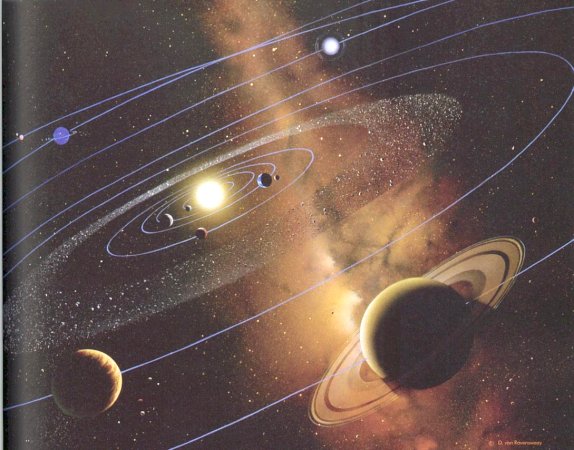
The Solar System


The Solar System consists of the Sun and those celestial objects bound to it by gravity. These objects are the eight planets, their 166 known moons, five dwarf planets, and billions of small bodies. The small bodies include asteroids, icy Kuiper belt objects, comets, meteoroids, and interplanetary dust.
The charted regions of the Solar System are the Sun, four terrestrial inner planets, the asteroid belt, four gas giant outer planets, the Kuiper belt, the scattered disc, and the hypothetical Oort cloud.
A flow of plasma from the Sun (the solar wind) permeates the Solar System. This creates a bubble in the interstellar medium known as the heliosphere, which extends out to the middle of the scattered disc.
In order of their distances from the Sun, the eight planets are:
1. Mercury
2. Venus
3. Earth
4. Mars
5. Jupiter
6. Saturn
7. Uranus
8. Neptune
As of mid-2008, five smaller objects are classified as dwarf planets. Ceres is in the asteroid belt, and four orbit the Sun beyond Neptune: Pluto (formerly classified as the ninth planet), Haumea, Makemake, and Eris.
Six of the planets and three of the dwarf planets are orbited by natural satellites, usually termed "moons" after Earth's Moon. Each of the outer planets is encircled by planetary rings of dust and other particles.

Mount Everest


Hi people, today our discussion is going to be about Mount Everest, also called Chomolungma, Sagarmatha - meaning Head of the Sky is the highest mountain on Earth, as measured by the height of its summit above sea level, which is 8,848 meters (29,029 ft). The mountain, which is part of the Himalaya range in High Asia, is located on the border between Sagarmatha Zone, Nepal, and Tibet, China.In 1856, the Great Trigonometric Survey of India established the first published height of Everest at 29,002 ft (8,840 m), although at the time Everest was known as Peak XV. In 1865, Everest was given its official English name by the Royal Geographical Society upon recommendation of Andrew Waugh, the British Surveyor General of India at the time. Waugh was unable to propose an established local name due to Nepal and Tibet being closed to foreigners at the time, although Chomolungma had been in common use by Tibetans for centuries.The highest mountain in the world attracts climbers of all levels, from well experienced mountaineers to novice climbers willing to pay substantial sums to professional mountain guides to complete a successful climb.
Everest has claimed 210 lives, including eight who perished during a 1996 storm high on the mountain. Conditions are so difficult in the death zone that most corpses have been left where they fell, some of which are visible from standard climbing routes. Thus it is hard to climb” The Mount Everest”… If you like to climb it become ready to accept losses… It is not a Mount, it is a land of death.

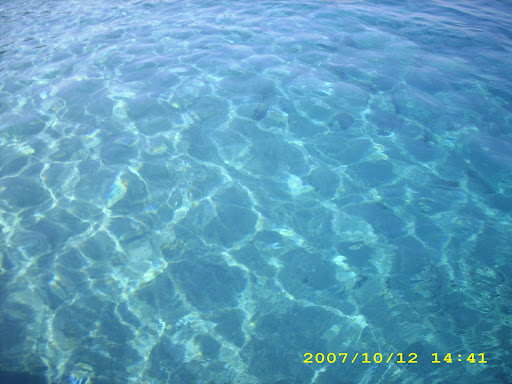
Blue sea


Hi friends it’s time for me to ask you a small question… The Question is “Why the sea appears blue?”

If you don’t know, I’m ready to give you the answer. There are 2 reasons for the sea to appear blue.

The sea reflects the sky.

You have probably noticed that the sea is not very blue-looking when the sky is overcast. Water reflects and scatters the light that strikes it; this is shown by the fact that you can see your reflection in puddles. When the sky is brilliant blue, the sea is also, because it reflects the blue of the sky.

The sea refracts light

Blue light is more easily bent, or refracted, than red light; thus, light refracted back from the surface of the sea appears blue. Furthermore, when you are underwater the water around you appears blue because more blue light is scattered back to your eye than red light.

Ok now your doubt is cleared, right! See you guys later, Bye……

Rainbow


Hi friends, I know that it will be a nice one to see a rainbow on the sky during rainy seasons… But any one had ever thought about how it is formed… If not, don’t worry. Reveal of the unknown is there for you to reveal you these information’s.
Rainbows are optical illusions and meteorological phenomena that cause a spectrum of light to appear in the sky when the Sun shines onto droplets of moisture in the Earth's atmosphere. They take the form of a multicolored arc, with red on the outer part of the arch and violet on the inner section of the arch. More rarely, a secondary rainbow is seen, which is a second, fainter arc outside the primary arc, with colors in the opposite order, that is, with violet on the outside and red on the inside.
Rainbows can be caused by other forms of water than rain, including mist, spray, dew, fog, and ice. Moreover, rainbows can have shapes other than a bow (arc), including stripes, circles, or even flames.
Rainbows can be observed whenever there are water drops in the air and sunlight shining from behind a person at a low altitude angle (on the ground). The most spectacular rainbow displays happen when half of the sky is still dark with draining clouds and the observer is at a spot with clear sky in the direction of the Sun. The result is a luminous rainbow that contrasts with the darkened background.
The rainbow effect is also commonly seen near waterfalls or fountains. Rainbow fringes can sometimes be seen at the edges of backlit clouds and as vertical bands in distant rain. The effect can also be artificially created by dispersing water droplets into the air during a sunny day. Rarely, a moon bow, lunar rainbow or night-time rainbow, can be seen on strongly moonlit nights. As human visual perception for color is poor in low light, moon bows are often perceived to be white.
Thus I believe that, this information will be helpful for you know about the formation of rainbows. Thanks for reading this post and have a nice day…

Artic Ocean

Today due to Global Warming many things are changing in this world. Due to this the ice bergs in Artic and Atlantic Ocean are melting at regular intervals. Definitely this will cause so much problems t all of us in future, now itself we are experiencing many problems. So for tha sake of some useful information we will see some interesting facts about the Artic Ocean. The Arctic Ocean, located in te northern hemisphere and mostly in the Arctic north polar region, is the smallest and shallowest of the world's five major oceans. The International Hydrographic Organization (IHO) recognizes it as an ocean, although some oceanographers call it the Arctic Mediterranean Sea or simply the Arctic Sea, classifying it as one of the mediterranean seas of the Atlantic Ocean. Alternatively, the Arctic Ocean can be seen as the northernmost lobe of the all-encompassing World Ocean.


Almost completely surrounded by Eurasia and North America, the Arctic Ocean is largely covered by sea ice throughout the year. The Arctic Ocean's temperature and salinity vary seasonally as the ice cover melts and freezes; its salinity is the lowest on average of the five major oceans, due to low evaporation, heavy freshwater inflow from rivers and streams, and limited connection and outflow to surrounding oceanic waters with higher salinities. The summer shrinking of the ice has been quoted at 50%. The National Snow and Ice Data Center NSIDC use satellite data to provide a daily record of Arctic sea ice cover and the rate of melting compared to an average period and specific past years.

I hope that this post is informative to all of you. Wait for more...

Titan Arum


The titan arum or Amorphophallus titanum (from Ancient Greek amorphos, "without form, misshapen" + phallos, "penis", and titan, "giant") is a flowering plant with the largest unbranched inflorescence in the world. The largest single flower is borne by the Rafflesia arnoldii; the largest branched inflorescence in the plant kingdom belongs to the Talipot palm (Corypha umbraculifera). The titan arum was originally discovered by an Italian botanist, Odoardo Beccari, in Sumatra in 1878. Though found in many botanic gardens around the world it is still indigenous only to the tropical forests of Sumatra. Due to its fragrance, which is reminiscent of the smell of a decomposing mammal, the titan arum is also known as a carrion flower, the "Corpse flower", or "Corpse plant" (in Indonesian, "bunga bangkai" – bunga means flower, while bangkai means corpse or cadaver; for the same reason, the same title is also attributed to Rafflesia which, like the titan arum, also grows in the rainforests of Sumatra). The popular name titan arum was invented by the broadcaster and naturalist Sir David Attenborough, for his BBC TV series The Private Life of Plants, in which the flowering and pollination of the plant were filmed for the first time. Attenborough felt that constantly referring to the plant as Amorphophallus on a popular TV documentary would be inappropriate.

The titan arum's inflorescence can reach over 3 metres (almost 10 ft.) in height. Like the related cuckoo pint and calla lily, it consists of a fragrant spadix of flowers wrapped by a spathe, which looks like the flower's single petal. In the case of the Titan Arum, the spathe is green on the outside and dark burgundy red on the inside, and deeply furrowed. The spadix is hollow, pale yellow and resembles a large loaf of French bread. The upper, visible portion of the spadix is covered in pollen, while its lower extremity is spangled with bright red-orange carpels. The "fragrance" of the inflorescence resembles rotting meat, attracting carrion-eating beetles and Flesh Flies (family Sarcophagidae) that pollinate it. The flower's deep red color and texture contribute to the illusion that the spathe is a piece of meat. During bloom, the tip of the spadix is approximately human body temperature, which helps the perfume volatilize; this heat is also believed to assist in the illusion that attracts carcass-eating insects.

Kingdom: Plant

Division: Magnoliophyta

Class: Liliopsida

Order: Alismatales

Family: Araceae

Genus: Amorphophallus

Species: A. titanum

Binomial name

Amorphophallus titanum

Both male and female flowers grow in the same inflorescence. The female flowers open first, then a day or two following, the male flowers open. This prevents the flower from self-pollinating.

After the flower dies back, a single leaf, which reaches the size of a small tree, grows from the underground corm. The leaf grows on a semi-green stalk that branches into three sections at the top, each containing many leaflets. The leaf structure can reach up to 6 m (20 ft) tall and 5 m (16 ft) across. Each year, the old leaf dies and a new one grows in its place. When the corm has stored enough energy, it becomes dormant for about 4 months. Then, the process repeats.

Largest tree


Hey friends, now its time to know about the world’s largest tree…Trees growing larger is not a matter at all, but growing his much larger is a noticeable one. The General Sherman tree is the largest tree (by volume) in the world. It can be found in Sequoia National Park. The General Sherman tree isn't the oldest in the park, however it is the largest. There is no other living thing in the world that is larger in volume than this tree.

Each year it adds enough wood to itself to make a tree one foot in diameter and more than 100 feet tall.

More stats:

Estimated Age: 2150 years

Height 274.9ft or 83.8m

Circumference at Ground 102.6ft or 31.1m

Maximum Diameter at Base 36.5ft or 11.1m

Diameter of Largest Branch 6.8ft or 2.1m

Height of First Large Branch above the Base 130.0ft or 39.6m

Average Crown Spread 106.5ft or 32.5m

Dwarf Willow


Salix herbacea (Dwarf Willow, Least Willow or Snowbed Willow) is a species of tiny creeping willow (family Salicaceae).

Leaves and seed capsules

Leaves and seed capsules

It is adapted to survive in harsh Arctic and sub-Arctic environments, and has a wide distribution on both sides of the North Atlantic, in Arctic northwest Asia, northern Europe, Greenland, and eastern Canada, and further south on high mountains, south to the Pyrenees, the Alps and the Rila in Europe, and the northern Appalachian Mountains in New York, United States. It grows in tundra and rocky moorland, usually at over 1,500 m altitude in the south of its range but down to sea level in the Arctic.

It is one of the smallest woody plants in the world. It typically grows to only 1-6 cm in height and has round, shiny green leaves 1-2 cm long and broad. Like the rest of the willows, Dwarf Willow is dioecious, with male and female catkins on separate plants. As a result the plant's appearance varies; the female catkins are red-coloured, while the male catkins are yellow-coloured.

About this blog

Hi friends, welcome to my blog. In this blog you can able to know some information about the matters that are not explored to you well (i.e. some unusual things). Enjoy reading my blog and have a nice time.
Update in this blog will be done at least once in 4 days...