White Tiger


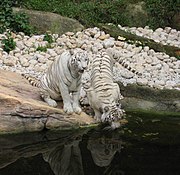
White Tiger (Panthera tigris) is a tiger with a genetic condition that nearly eliminates pigment in the normally orange fur although they still have dark stripes. This occurs when a tiger inherits two copies of the recessive gene for the paler coloration: pink nose, grey-mottled skin, ice-blue eyes, and white to cream-coloured fur with black, grey, or chocolate-coloured stripes. (Another genetic condition also makes the stripes of the tiger very pale; white tigers of this type are called snow-white.)

White tigers do not constitute a separate subspecies of their own and can breed with orange ones, although all of the resulting offspring will be heterozygous for the recessive white gene, and their fur will be orange. The only exception would be if the orange parent was itself already a heterozygous tiger, which would give each cub a 50% chance of being either double-recessive white or heterozygous orange.

Compared to orange tigers without the white gene, white tigers tend to be larger both at birth and at full adult size. This may have given them an advantage in the wild despite their unusual coloration. Heterozygous orange tigers also tend to be larger than other orange tigers. Kailash Sankhala, the director of the New Delhi Zoo in the 1960s, suggested that "one of the functions of the white gene may have been to keep a size gene in the population, in case it's ever needed."

Dark-striped white individuals are well-documented in the Bengal Tiger subspecies (Panthera tigris tigris or P. t. bengalensis), may also have occurred in captive Siberian Tigers (Panthera tigris altaica), and may have been reported historically in several other subspecies. White pelage is most closely associated with the Bengal, or Indian subspecies. Currently, several hundred white tigers are in captivity worldwide with about 100 of them in India, and their numbers are on the increase. The modern population includes both pure Bengals and hybrid Bengal–Siberians, but it is unclear whether the recessive gene for white came only from Bengals, or from any of the Siberian ancestors as well.

The unusual coloration of white tigers has made them popular in zoos and entertainment that showcases exotic animals. The magicians Siegfried & Roy are famous for having bred and trained white tigers for their performances, referring to them as "royal white tigers" perhaps from the white tiger's association with the Maharaja of Rewa.

It is a myth that white tigers did not thrive in the wild, where small groups had bred white for generations. India once planned to reintroduce them to the wild. Dunbar Brander wrote in "Wild Animals In Central India" (1923): "White tigers occasionally occur. There is a regular breed of these animals in the neighborhood of Amarkantak at the junction of the Rewa state and the Mandla and Bilaspur districts. When I was last in Mandla in 1919, a white tigress and two three parts grown white cubs existed. In 1915 a male was trapped by the Rewa state and kept in confinement. An excellent description of this animal by Mr. Scott of the Indian police, has been published in Vol. XXVII, No. 47, of the Bombay Natural History Society's journal."

Mammoth


A mammoth is any species of the extinct genus Mammuthus. These are members of the elephant family and close relatives of modern elephants. They were often equipped with long curved tusks and, in northern species, a covering of long hair. They lived from 4.8 million years ago to around 4,500 years ago.

The woolly mammoth was the last species of the genus. Most populations of the woolly mammoth in North America and Eurasia died out at the end of the last Ice Age. Until recently it was generally assumed, that the last woolly mammoths vanished from Europe and Southern Siberia about 10,000 BC, but new findings show, that some were still present here about 8,000 BC. Only slightly later the woolly mammoths also disappeared from continental Northern Siberia. Woolly mammoths as well as Columbian mammoths disappeared from the North American continent at the end of the ice age. A small population survived on St. Paul Island, Alaska, up until 6000 BC, and the small mammoths of Wrangel Island became extinct only around 2000 BC.

About there body…

Height - 5 meters (min) & 6.7 meters (max)

Weight - 6 to 12 tones

Tusk – upto 4.1 meters

Based on studies of their close relatives, the modern elephants, mammoths probably had a gestation period of 22 months, resulting in a single calf being born. Their social structure was probably the same as that of African and Asian elephants.

If such animals are still existing, it will be exciting for us to watch them and no more elephants will be called as big as well as large animals…

They were no more but still as fossils…

Disclosure Policy

This blog is a personal blog written and edited by me. For questions about this blog, please email selerines@gmail.com
This blog accepts forms of cash advertising, sponsorship, paid insertions or other forms of compensation.
This blog abides by word of mouth marketing standards. We believe in honesty of relationship, opinion and identity. The compensation received may influence the advertising content, topics or posts made in this blog. That content, advertising space or post will be clearly identified as paid or sponsored content.
The owner(s) of this blog is compensated to provide opinion on products, services, websites and various other topics. Even though the owner(s) of this blog receives compensation for our posts or advertisements, we always give our honest opinions, findings, beliefs, or experiences on those topics or products. The views and opinions expressed on this blog are purely the bloggers’ own. Any product claim, statistic, quote or other representation about a product or service should be verified with the manufacturer, provider or party in question.

Airbus


Here we will see about the Airbus and its history. Airbus Industrie began as a consortium of European aviation firms to compete with American companies such as Boeing, McDonnell Douglas, and Lockheed.

While many European aircraft were innovative, even the most successful had small production runs.In 1991, Jean Pierson, then CEO and Managing Director of Airbus Industrie, described a number of factors which explained the dominant position of American aircraft manufacturers: the land mass of the United States made air transport the favoured mode of travel; a 1942 Anglo-American agreement entrusted transport aircraft production to the US; and World War II had left America with "a profitable, vigorous, powerful and structured aeronautical industry."

In the mid-1960s, tentative negotiations commenced regarding a European collaborative approach. Individual aircraft companies had already envisaged such a requirement; in 1959 Hawker Siddeley had advertised an "Airbus" version of the Armstrong Whitworth AW.660 Argosy, which would "be able to lift as many as 126 passengers on ultra short routes at a direct operating cost of 2d. per seat mile." However, European aircraft manufacturers were aware of the risks of such a development and began to accept, along with their governments, that collaboration was required to develop such an aircraft and to compete with the more powerful US manufacturers. At the 1965 Paris Air Show major European airlines informally discussed their requirements for a new "airbus" capable of transporting 100 or more passengers over short to medium distances at a low cost. The same year Hawker Siddeley (at the urging of the UK government) teamed with Breguet and Nord to study airbus designs. The Hawker Siddeley/Breguet/Nord groups HBN 100 became the basis for the continuation of the project. By 1966 the partners were Sud Aviation (France), Arbeitsgemeinschaft Airbus, later Deutsche Airbus (Germany) and Hawker Siddeley (UK).

Headquarters Toulouse, France

Key people Thomas Enders, CEO

Hans Peter Ring, CFO

John Leahy, Chief Commercial Officer

Fabrice Brégier, COO

Industry Aerospace

Products Commercial airliners (list)

Revenue $39 billion USD (FY 2006)[1]

Employees 57,000 [2]

Parent EADS

Subsidiaries Airbus Military

Website www.airbus.com

Mokele-mbembe


Hi friends, here it is an interesting topic about an unknown animal to you…… It is nothing but Mokele-mbembe: meaning "one who stops the flow of rivers" in the Lingala language, is the name given to a large water dwelling cryptid(name of its grouping) found in the folklore of the Congo River basin. It is sometimes described as being a living creature and sometimes as being a spirit.

Several expeditions have been mounted in the hope of finding evidence of the Mokele-mbembe, though without success. Efforts have been covered in a number of books and by a number of television documentaries. The Mokele-mbembe and its associated folklore also appears in several works of fiction and popular culture.

According to the traditions of the Congo River basin the Mokele-mbembe is a large territorial herbivore, approximately the size of an small elephant or a large hippopotamus. It dwells in the Congo river and the surrounding swampland, and has a preference for deep water, with local folklore holding that its habitat of choice are river bends.

Descriptions of the Mokele-mbembe, by some legends describe that, it as having an elephant like body with a long neck and tail and a small head. It has been first seen and reported in the year 1776(march) and last sighted by Eugene Thomas in the year 1989 at the congo river basin.

This information tells that, the dinosauras family is still living on the earth. Since it is an herbivores, lets hope it will not eat the mankind……

Amazon Rainforest


The Amazon River Basin is home to the largest rainforest on Earth. It covers some 40% of the South American continent and includes parts of eight South American countries: Brazil, Bolivia, Peru, Ecuador, Colombia, Venezuela, Guyana, and Suriname, as well as French Guiana, a department of France.


Reflecting environmental conditions as well as past human influence, the Amazon is made up of a mosaic of ecosystems and vegetation types including rainforests, seasonal forests, deciduous forests, flooded forests, and savannas. The basin is drained by the Amazon River, the world's largest river in terms of discharge, and the second longest river in the world after the Nile. The river is made up of over 1,100 tributaries, 17 of which are longer than 1000 miles, and two of which (the Negro and the Madeira) are larger, in terms of volume, than the Congo (formerly the Zaire) river. The river system is the lifeline of the forest and its history plays an important part in the development of its rainforests.

How large is the Amazon rainforest?
In Brazil, the Amazon covers surface area of 4,100,000 square kilometers (1,583,000 square miles), of which around 3.4 million sq km (1.3 million sq mi) are presently forested. Accounting for parts of the Amazon outside of Brazil, the total extent of the Amazon is estimated at 8,235,430 sq km (3,179,715 sq mi). or comparison, the land area of the United States (including Alaska and Hawaii) is 9,629,091 square kilometers (3,717,811).

In total, the Amazon River drains about 6,915,000 square kilometers (2,722,000 square miles), or roughly 40 percent of South America.

To date, at least 40,000 plant species, 3,000 fish, 1,294 birds, 427 mammals, 428 amphibians, and 378 reptiles have been scientifically classified in the region.

Many mammals, still not known are also living in this forest. But deforestation taking place in these area’s will surely affect the life of these mammals. So Amazon should be protected from deforestation, otherwise the result will be very bad

Bermuda's triangle


Hi friends, this is my first post and is going to be about the worlds mystery "BERMUDA'S TRIANGLE"(also known as Devil's triangle).No doubt you have wondered about the Bermuda Triangle. It is the greatest modern mystery pf our supposedly well understood world: a region of Atlantic ocean between Bermuda, Miami, Florida, and San Juan, Puerto Rico, where disappearances of ships & planes not only continue but continue to defy explanation.

Storms are common in the region, and investigations to date have not produced scientific evidence of any unusual phenomena involved in the disappearances.

Some people were saying that ,this disappearances are due to the storms in that region and others are saying that,it is due to the heavy gravitational force in that area and some guys says that,it is due to some ghosts that are living under the see in that region and the imaginary skills of the people goes on ascending.

Recent Aircraft disappearances include:

Piper PA-46-310P N444JH on April 10, 2007, near Berry Islands.(under investigation)

Piper PA-23 N6886Y on June 20, 2005, Between Treasure Cay, BI, to Fort Pierce, FL (possible foul weather)

Piper PA-32-300 N8224C, November 13, 2003, over the Exumas, Bahamas. (No known cause)

What will be the reason for this disappearances........... Need to find a solution.

For more information use the links

Link 1

Link 2


About this blog

Hi friends, welcome to my blog. In this blog you can able to know some information about the matters that are not explored to you well (i.e. some unusual things). Enjoy reading my blog and have a nice time.
Update in this blog will be done at least once in 4 days...